
Caedda’s Cross
A contest-losing short story

This is a short story that I wrote for a contest. It didn’t win. Philistines! I entered it in another contest, and it didn’t win that one either. I am surrounded by Philistines. But you, my lovely subscribers, are not Philistines, so I present it to you.
It’s not the sort of story that I would usually write. It was written specifically for the contest theme, but it did give me a chance to use some of the research I have done for my Cuthbert’s People series. And in the end, I was rather pleased with it. The Heliand, to which it makes reference, is a fascinating Anglo-Saxon retelling of the gospels in which Jesus is depicted as a great chieftain and the disciples as his warrior band.
Caedda’s Cross
Their spears they used as walking staffs. Their shields they slung behind them to keep the wind from their backs. Brothers they were, sons of the same father, weaned from the same breast. Two in number. One in blood.
Lower down, they had seen a sheep and had wearied themselves in pursuit of it, without fruit. Their legs were scratched from plunging about through the tough gorse, and their boots and leggings were soaked from the peat bog they had stumbled into, which had lain impenetrable and unseen between them and their last hope of meat. The sheep, noticing them at last, had turned its long, dour face towards them and uttered a single bleat of mockery before shambling off without much hope in pursuit of the flock that had left it behind.
Higher up, they had seen a lean fox with bloody jaws and jealously cast their spears at it. The fox, too, had mocked them by the indifference with which it ambled away. It had been a weary and unfruitful business then to leave the upward path and push through grasping heather to retrieve their spears.
“Do you know where you’re going, Caedda?” the younger asked because the path seemed ever upward and the silence between them had grown too heavy for him to bear.
“I know what I’m leaving,” Caedda answered. Two days before, they had been a company, twenty men, unblooded but keen, the hope of their village, the longing of as many young women, their fathers’ pride, their mothers’ hearts’ dread.
“I think I saw Baldwine and Wybert running east,” the younger, Eadwig, said, to keep the wind-borne silence an arm’s length from his soul.
“Straight into more of them if they did,” Caedda said. Caedda did not fear the silence. It was like the night to him, for he hoped only to pass unseen and unheard.
“My side hurts,” Eadwig said.
“Can’t help that,” Caedda said. His brother, at least, would have a scar to show for the encounter, to prove that he had stood and faced the foe like a man, for a moment at least. Caedda’s own flesh was unmarked. He bore no token of his courage. Could any man flee the field of ignominy unmarked and hold his honor?
Eadwig took no comfort in his wound. For a while, he did not speak, but the wind that buffeted him and taunted him with its unbearable silence wore him down.
“Will they come after us?” he asked.
Caedda trudged on upward without answering. The horizon seemed to roll on ever higher before his eyes, as if it were always a mile or a half mile more, like swimming against the current of a river.
“Did you see what happened to the king?” Eadwig asked.
The crest toward which they had been climbing revealed beyond itself another crest, another climb.
“The old men say it is the worst dishonor for the king’s guard to live if the king falls,” Eadwig said.
“We weren’t king’s guard.”
“Are we dishonored?”
“You have your wound, don’t you? Stop complaining.”
“It hurts.”
No answer. Another weary, silent mile. The bracken and the gorse had all fallen behind. About them now was only wild brown grass and grey, silent stones.
“I’m cold.”
“We’ll stop when it gets dark. Safer then.”
“I’m like to die of cold.”
“We are both like to die. Less like if we keep walking.”
“I am foot sore.”
“I am heart sore.”
“You’re not walking on your heart,” Eadwig bleated.
“I’ll walk on yours if you are not silent, brother.”
Another silent mile passed beneath their boots, the sharp-stoned path reeling and weaving as it climbed, as if formed by the passage of an age of stumbling heartsore men.
“The silence is like to death,” Eadwig cried, the bitter wind bringing forth water from the corners of his eyes.
“Your chatter is like to Hell,” Caedda replied.
Eadwig fell silent a moment, but it seemed that if he did not speak he would lose all heart. “But Heaven is like to singing in the hall,” he said, “with fair maidens to recount your deeds in song, and good meat, and rich sweet wine to drink.”
“You’ll test that soon enough if you’re not quiet,” Caedda snapped.
“Oh, do not make me die in silence, brother,” Eadwig pleaded. “Sing to me while the life goes out of my breast.”
“I’ll sing to thee when you lie dying, brother,” Caedda said. “If you’ll but give me peace while still we live and walk.”
“The silence is like the grave,” Eadwig complained. “My wound grows right sore, and my head is all a whirling with the silence.”
“Are there not voices enough on the wind?” Caedda complained. “I hear the whole host of the dead crying on the wind.”
“They are silence to me, brother. I cannot hear them. I need a living voice to give me heart.”
“But I have not the heart to sing,” Caedda said.
And then they both grew silent and went on.
Night came down over the mountain like a shroud, and there were naught but demons on the wind. Their hearts went out of them both together, and Caedda stopped and took his brother in his arms. “I will sing to you all through the night, brother,” he said, “till the light returns in the morning.”
“I am cold, and my wound is afire,” Eadwig replied. “Sing to me, for I shall not see the morning.”
Then Caedda sank down onto the bare mountain, and Eadwig sank down beside him and laid his head on his breast, and Caedda sang to him.
Now must we hymn the Master of heaven,
The might of the Maker, the deeds of the Father,
The thought of His heart. He, Lord everlasting,
Established of old the source of all wonders:
Creator all-holy, He hung the bright heaven,
A roof high upreared, o’er the children of men;
But as he sang, it seemed that another voice joined with Caedda’s, and they looked about them and saw that there was a shaft of light illuming the pass above them, as if the last light of the declining sun had found a passage between the cloud and the unseen land beyond and sent through one last red-gold ray. And from the place where the light struck, a deep voice came to them through the hurrying darkness.
The King of mankind then created for mortals
The world in its beauty, the earth spread beneath them,
He, Lord everlasting, omnipotent God.
They rose and went on together, Caedda’s arm firm about his brother’s back to lend strength to his failing legs. They came very soon to the head of the pass, though before it had seemed as far above them as at their first steps upon the mountain.
As they approached the summit, they saw, outlined by that last shaft of sunlight, a great stone cross. The height of two men it stood, and where the crosspieces met there was a ring of stone so that it might have been like a shield hung on crossed spears, except that the trunk and arms were as broad and thick as a man’s chest. The face of the cross was black as pitch with the cloud-stooped sun behind it, but its sides glowed red as life’s blood in the dying of the day.
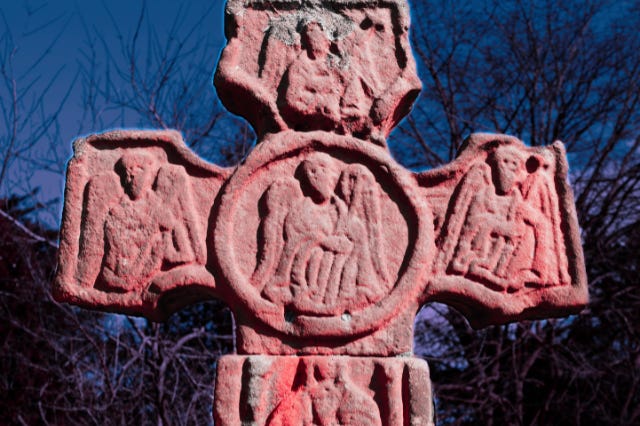
When they reached the cross, which stood beside the path at the very summit of the pass, they found an old man with a hammer and chisel in his hand. He was chipping away at the stone, carving a scene into one of the several panels that were set into the surface of the cross. He seemed untroubled by the coming of the darkness, tapping away placidly, not hurrying to race the dying light. And while he tapped and carved, he sang.
“Be well, good friends,” he said, as they drew by him. “I am Oswine the Maker. What news do you bring me from the world of men?”
“Be well, Father,” Caedda said. “I am Caedda, and this is Eadwig, my brother. The news is that a great heathen army lies camped upon the plain below, finding their rest among the bones of Christian dead. I would not linger in this place, if I were you, for if they find this pass, they are certain to send blood-hardened men to scout it in the morning.”
“They will not come this way a while,” Oswine the Maker said, “though in time they will surely come.”
It was warmer in that place, and the wind seemed to have died, though all around, the sound of rushing air filled the silent night. Caedda looked about and saw that there was a brazier standing near, bright with flame, its light seeming as one with the light of the distant sun, and from this, he thought, must come the heat that cheered them even in this high, dark, wind-scoured spot.
“My brother took a wound in the battle,” Caedda said. “It has made him weary, and he feels the cold.”
“Sit him down by the fire,” the old man said, “and I will see what I can do for him.” Caedda helped Eadwig to sit by the brazier. In its light, Eadwig’s face, which had been as white as milk, shone ruddy as that of a newborn child, still flushed from the trial of its birthing.
Oswine the Maker sat down on his haunches. Eadwig pulled up his tunic and showed the wound.
“I had one like it once,” the old man said, “and from the selfsame spear.”
“But you lived,” Eadwig said. “Will I live also?”
“Oh, assuredly you will live,” Oswine answered. “In the morning, you will travel with me to my father’s hall, and there, there will be feasting, and the fairest of all maidens shall tell of the bravery with which you faced the foe. But first, will you take some nourishment with me, food for our journey?”
“We would not rob you of your only sustenance, Father,” Caedda said. “But if you can spare a little meat for my brother’s belly, I will be in your debt. I can go many days without when I have need, but a little meat may be the life for him.”
“Oh, have no fear,” Oswine said. “We are but a small company, and well met. There will be food enough for all.”
Oswine went and took three small fish from a bag that lay near the brazier, and he laid them upon a grill and placed it over the coals of the brazier.
“This is a strange place for a cross, old man,” Caedda said. “Such a fine piece should stand in the center of a town, or in the courtyard of a king’s hall.”
“It stands here to mark the way,” Oswine said, “And to give heart to those who climb this narrow stone-thronged thorn-thatched path.”
“A simple milestone could mark the way as well,” Caedda said.
“But come and see,” Oswine the Maker said. “Let me show you this panel that I am carving. You see here? This is the great Chieftain, the Heliand. See how he puts forth his hand, and the waves obey him. See how his thegns cower in their boats, fearing the fury of the waves. But he calms the sea and all come safe to shore. Is this not a scene to give heart to a man who makes his way across a land as barren as the sea, buffeted by winds with all the fury of a gale?”
“My eyes must be weary, Father, for it seems almost as if the figures in the rock move as you tell the tale.”
“Oh, that may be nothing but the movement of the light across the stones,” Oswine said.
“But surely that must be due to some great skill on the part of the maker,” Caedda said.
“I must go and turn the fish,” Oswine said, and left his side.
Caedda looked at the panel above the one the old man had described to him. The sun seemed to have taken its rest upon the far horizon, for still its rays fell as before upon the cross. The next panel showed the great Chieftain, the Heliand, as in the panel before, but here he stood upon a mountainside with a great crowd around him, and his warrior companions walked through the crowd with baskets that were overflowing with bread.
He turned then to return to the fire and to his brother’s side, and he saw that Oswine and Eadwig were sitting opposite each other, their features seeming to dance in the light of the flickering brazier, and they were singing softly together, and a look of great peace had come over his brother’s face. He hurried near to catch the note of their song, but before he was near enough, Oswine the Maker leapt up with an agility that belied the years written on his face. He said, “I think the fish is ready. Sit and we shall eat.”
Oswin went to the brazier, and when he returned to them, he handed each of them a feasting board, and on each board there was a fine fat salmon, its scales brown and crisped by the fire, and its eyes white and staring. Then each man took out his knife and cut off the head and the tail of his fish, and pulled out the bones. A flock of ravens landed among them, unafraid, and took the heads and the tails and the bones and flew off with them in their beaks. The men ate, and the flesh was sweeter than any Caedda had tasted, even when he had sat on the low benches, furthest from the fire, in the hall of the king.
“How did you come by such magnificent fish on this barren mountain?” Caedda asked.
“I have thegns among my retinue who are great fishermen,” Oswine replied.
“But we are far above any stream in which such a noble fish as this could swim,” Caedda said. “And the flesh is so sweet, without any note of corruption, it must have been caught today.”
“Eat,” Oswine replied. “A gracious guest does not let the meal grow cold that his host has taken such trouble to prepare for him.”
So Caedda ate, and though he had not had a meal in two days, and the fish was a finer meat than he had known in all his days, yet it mattered not how much he ate but his board was never empty. At last, he said, “I would not for the world offend my host, but if I ate more I think I would burst. Brother,” he added, “if you hunger still, I pray you eat of my surplus.”
“Nay, brother,” Eadwig replied, in a voice that seemed stronger and more at peace than he had heard it since first the two of them had heeded the call to fight the Dane and had quit their mother’s hearth. “I am sated. I could not ask for more.”
“You must be thirsty then, after so much meat,” Oswine the Maker said. “Friend Caedda, I have a skin there in my pack. If you listen, you will hear a small stream running yonder. You can see the water glitter in the light of the sun. Fill it for me, I pray you.”
Caedda took the skin, and as Oswine had said, he heard a small stream running near, and saw the light of the sun dancing on the water, and wondered that the sun still hung upon the horizon, as if the warriors of the day were making a last stand against the thegns of the night, standing undaunted around their king, refusing to yield the field.
He dipped the mouth of the skin into the stream, the water chilling his hands until he fancied they must have turned as blue as the sea, yet when he looked at them in the light of the stubborn sun, they seemed blood red as everything it illumined.
When the skin was full, he rose to walk back to the brazier, but saw that Oswine and Eadwig had risen and were standing by the cross, and Oswine was showing one of the carved scenes to Eadwig and explaining it to him. And Eadwig, who not long since had seemed at the door of death, so pained by his wound that he could not stand, now seemed a man entirely healthy and at ease, his whole attention captured by the tale that the maker was telling.
“Ah, thank you, friend,” Oswine exclaimed, taking the filled skin that Caedda had brought to him. “Let us take our places by the fire again and slake our thirst.”
Oswine and Eadwig turned and made their way back to the fire. Caedda stayed for a moment to glance at the carved scene they had been examining. It showed a feasting hall, with many thegns and their ladies seated together, and at the head, a bride and groom in their wedding garb. But in the foreground, the figure of the great Chieftain stood, with the fairest of all maidens beside him. Caedda knew her to be such, for all that she was but a small figure carved in rough stone. The great Chieftain had his hand stretched out over stone vats, which slaves were filling with water.
“Won’t you join us and sing us a song, Caedda?” Oswine said from his place by the fire. “You have a fine voice, and it is good to have some merriment before we sleep.”
Then Oswine offered them each a goblet, bright silver, rich in gems and filigree of gold, and he filled them each from the skin that Caedda had filled, and Caedda sang, and the water was like wine on the tongue.
They all stood so firmly stiff-minded,
the young warriors in the battle, thinking eagerly
who they could soonest conquer
with their swords, the life of fated men,
the warriors with their weapons. Slaughter fell upon the earth.
They stood steadfast: Byrhtnoth exhorted them,
ordering every warrior to think upon the scrum,
who wished for glory in fighting the Danes.
And when Caedda’s long tale was finished, and they were all merry with the wine, Caedda asked Oswine the Maker to sing, and he agreed and began his song.
Lo! choicest of dreams I will relate,
What dream I dreamt in middle of night
When mortal men reposed in rest.
Methought I saw a wondrous wood
Tower aloft with light bewound,
Brightest of trees; that beacon was all
Begirt with gold; jewels were standing
Four at surface of earth, likewise were there five
Above on the shoulder-brace. All angels of God beheld it,
Fair through future ages; ’twas no criminal’s cross indeed,
But holy spirits beheld it there,
Men upon earth, all this glorious creation.
And when the song was finished, and their heads were sleepy from the wine and the lateness of the hour, Oswine looked towards the East and said, “The night has come upon us and the sun will in a moment sink below the distant hills. But before we sleep, one thing remains.”
Then he went to his pack and brought out a loaf of bread, broke it and blessed it and gave it to them, and though they had sated themselves upon the fish, yet for this bread they hungered, and they ate it.
Caedda recognized him then and said, “Lord, you are the Heliand, the King of kings.”
Oswine the Maker made a sign of blessing over him and said, “In the morning, your brother and I must travel onward by a different route. Mourn for your parting, but have no fear for him. He goes to be a thegn in my hall, which is everlasting.”
Caedda said, “Lord, may I not come with you as well, for I would fain dine in your hall tomorrow among your warrior companions, and taste the cup presented by the fairest of all maidens.”
But Oswine said, “Sleep now,” and darkness came, and Caedda slept.
In the morning, it was bitter cold when Caedda woke. Eadwig’s body lay within the compass of his arm, but it was colder still. Caedda shook his brother and called his name aloud until it echoed from the mountains around him, but Eadwig’s body lay stiff and cold, and there was no breath in him. Then Caedda looked about and called Oswine’s name, but the old man was gone, and of his bag, his chisels, and his brazier, there was no sign.
The golden light of morning fell on the great stone cross, and Caedda stood and went to it and knelt before it, and he saw that it was old and weathered, and lichen grew across the face of the rough, worn figures carved into its panels. But then he looked again and saw that there was bright blood, blood as red as rubies, glittering like the dew in the morning sun, and it marked the cross in five places, once at the head, once at the foot, once at the extremity of each of the arms, and once in the middle part, and he knelt there in the bitter air and wept.
Then Caedda built a cairn of stones over the body of Eadwig, his brother, and went home to bring the good news to his mother and his father. He served his king faithfully in the battle line until he grew too old to march, and then took him to a priory and grew cabbages there to feed his brothers until, in the fullness of his days, he saw Oswine the Maker coming across the field towards him and ran to meet him with glad shouts.
Note: Excerpts from Caedmon’s Hymn, The Battle of Maldon, and The Dream of the Rood are all taken from translations in the public domain. Descriptions of the gospel scenes carved on the cross are based on the Heliand, the Saxon Gospel poem.
For more Anglo-Saxon adventures, in a slightly different key, check out Cuthbert’s People.
This was SO beautiful 😍
Philistines indeed! Loved every part 👏