
Would the Classics be Published Today?
Or, why most writing advice is clear, actionable, and wrong

I once thought of writing a series of posts on great literary classics that would not get published today. But I realized that every classic would be on that list. None of them would get published today. I was interested, then, when Liza Libes published a post entitled The Great Works of Literature Would Not Be Published Today.
Libes's post is mostly a rant against literary agents for enforcing rules that Libes says would exclude the greats from consideration today. While I have much sympathy for Libes and the frustration of her hunt for an agent (a frustration I know all too well), I think her rant misses the mark a little. The agents she is criticising miss the mark too. But it is why they miss the mark, what pulls their advice a little bit off course, that I find really interesting.
Libes quotes various agents’ advice to writers and attempts to refute it by reference to the classics. Libes is not wrong that the agents’ advice sometimes lacks sophistication. But Libes’ argument is missing something too, and I don’t think she is being entirely fair to the agents she is criticizing. So let’s look at her arguments, not for the sake of knocking down either Libes (who you will know, if you have read her stuff, can take care of herself) or the agents she mentions, but because it illustrates something interesting about how the “rules” of literature are created and expressed, and why so many of them are wrong in effect even when there is a sound principle behind them.
Libes organizes her essay under headings that express the rules she is critiquing. I will use Libes’ headings to introduce the “rules” she rages against, and use them as examples of why writing advice tends to go awry:
Your Book Must Be Fewer Than 100,000 Words
Libes responds to this rule by pointing out how many books longer than 100,000 words have been published in the past. And of course they have. But, of course, the agent’s advice is addressed to unpublished writers that no one has heard of, the only people who are actually querying agents these days. Publishing unknown authors is risky. Long or short books increase the risk. Established authors who have cred with the public and the princes of publishing can do it. Newbies are making life hard for themselves if they try. The rule isn’t absolute, but it is applicable to most of those it is addressed to.

Your Book Must Introduce the Stakes Right Away
Here Libes quotes an agent’s blog:
The first pages are not the place for slow build-ups. Make sure you’re starting the story where the conflict or emotional tension begins. Place your character in the middle of an action or conversation that reveals something important about them.
Libes responds:
This prescription alone defies the standards of all great literature: any serious reader will know that the vast majority of classic novels begin with backstory, which makes characters come alive. There is nothing wrong with the hook of a story coming on page twenty! Hell—the inciting incident of Gatsby does not come until several chapters into the story!
Libes wants the characters to come alive. The agent says to reveal something important about them. Are these not the same thing? But I imagine Libes is reacting to the rejection of “slow build-ups.” It’s fair to say that many classics have a slower build-up than most modern works. But I would suggest to both Libes and the agent that slowness is not the point. The point is tension.
The opening of a story must strike a note. To strike a note, both the string and the bow must be in tension. Placing a character in the middle of an action or conversation is certainly one way to put string and bow in tension. But it is not the only way. Nor is it an infallible way. You can start a book with action or conversation and not strike a note at all because the conversation or action lacks all tension. Conversely, if you can successfully place the string and bow in tension, you can start a story with backstory and sustain the note until the main story begins. But this is not easy, and therefore it is not common.
Placing the string and bow in tension and sounding a pure note is difficult. Still more difficult is to develop a theme and a melody with harmony and counterpoint based on that first note. You can start with a single note, but that note must build and develop into the central theme of the novel, or the result will either be silence or a cacophanous mess.
The classics were written by people of extraordinary skill who were capable of building slowly and adding layers of complexity to their narrative while never letting the tension drop. Most writers are not capable of this. Most of us better break into a catchy jingle pretty quickly, or the musical tension will evaporate, if it was ever created in the first place. Some rules are designed to raise the hopeless to the level of mediocrity. They don’t apply to the gifted.
Liebs cites the opening of Anna Karenina as a counterexample to the agent’s rule:
Based on this agent’s insistence on introducing stakes right away, Anna Karenina certainly would not have been published today.
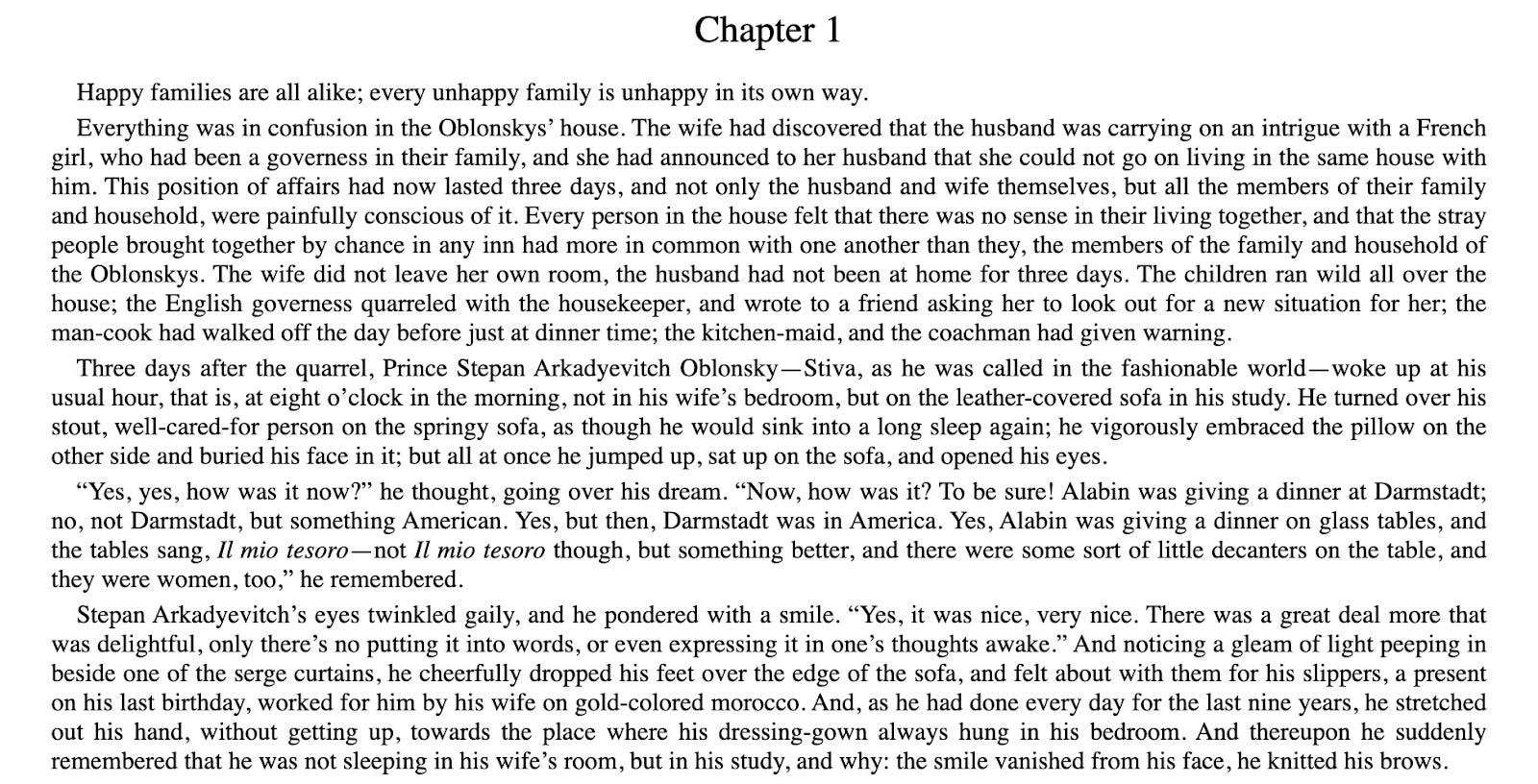
And yet this passage is starting the story exactly where the agent says it should start, “where the conflict or emotional tension begins”. A note has been struck. True, the main theme has not yet been introduced, but a note has been sounded, and that note will carry into the main theme. The agent’s principle is correct, but her practical advice is limited.
One issue here is what is meant by “stakes.” Stakes seem to mean what the protagonist has to win or to lose, and of course, one way to put tension in the string and the bow and sound that opening note is by introducing the stakes. But does it have to mean starting with the specific things that the protagonist stands to win or lose, and the reason that they might win or lose them? Sure, that’s an easy way to do it. And the agent is undoubtedly right that many writers spend pages and pages on backstory without any hint of what the stakes might be. Stakes, one might say, are the main tune, the central motif of the piece. But while stating the melody from the first note is one way to go, building slowly up to it is another, and one with much greater potential for drama.
In other words, though the stakes need not be stated in full in the opening pages, the opening pages must begin by establishing a narrative tension that leads and builds to the statement of the main stakes. It is to be doubted that most agents see a manuscript that does this well in a month of Sundays. We should not be surprised to find them recommending a more rapid approach. Again, the principle that the agent is stating is sound, but they are urging a simpler and more direct implementation of it than a great writer is capable of, and that the classics exemplify.
No Extraneous Details Permitted
Under this heading, Libes quotes the same agent:
Many writers begin with long-winded backstory or world building, leading to a slow build up that postpones the real action and slows the pace, overwhelming readers with unproductive information.
Tip: Kick things off by introducing the main character in action or giving us a hint of the inciting incident. You can ground the reader without providing every single detail up front. Provide info at the time it’s needed, as the story unfolds.
Having read quite a few unpublished manuscripts myself, I know where the agent is coming from. All the same, her words are inexact. It is not postponing the action that is the problem. It is failing to sound and sustain the note of tension that will carry the reader through to the place where the action begins. But the words “unproductive information” are on the money. Information is unproductive if it does not sound that note of tension that will eventually develop into the main theme of the story. Literally (and figuratively at the same time), it fails to produce a note. The problem is not its length; it is its failure to excite a vibration in the body of the instrument.
Leibs latches onto the word “unpoductive”:
Must all information given to us in a novel be productive? It is clear, for one, that this agent has never read John Steinbeck’s East of Eden—one of the most beautiful novels ever written that contains a deluge of so-called “unproductive” information.
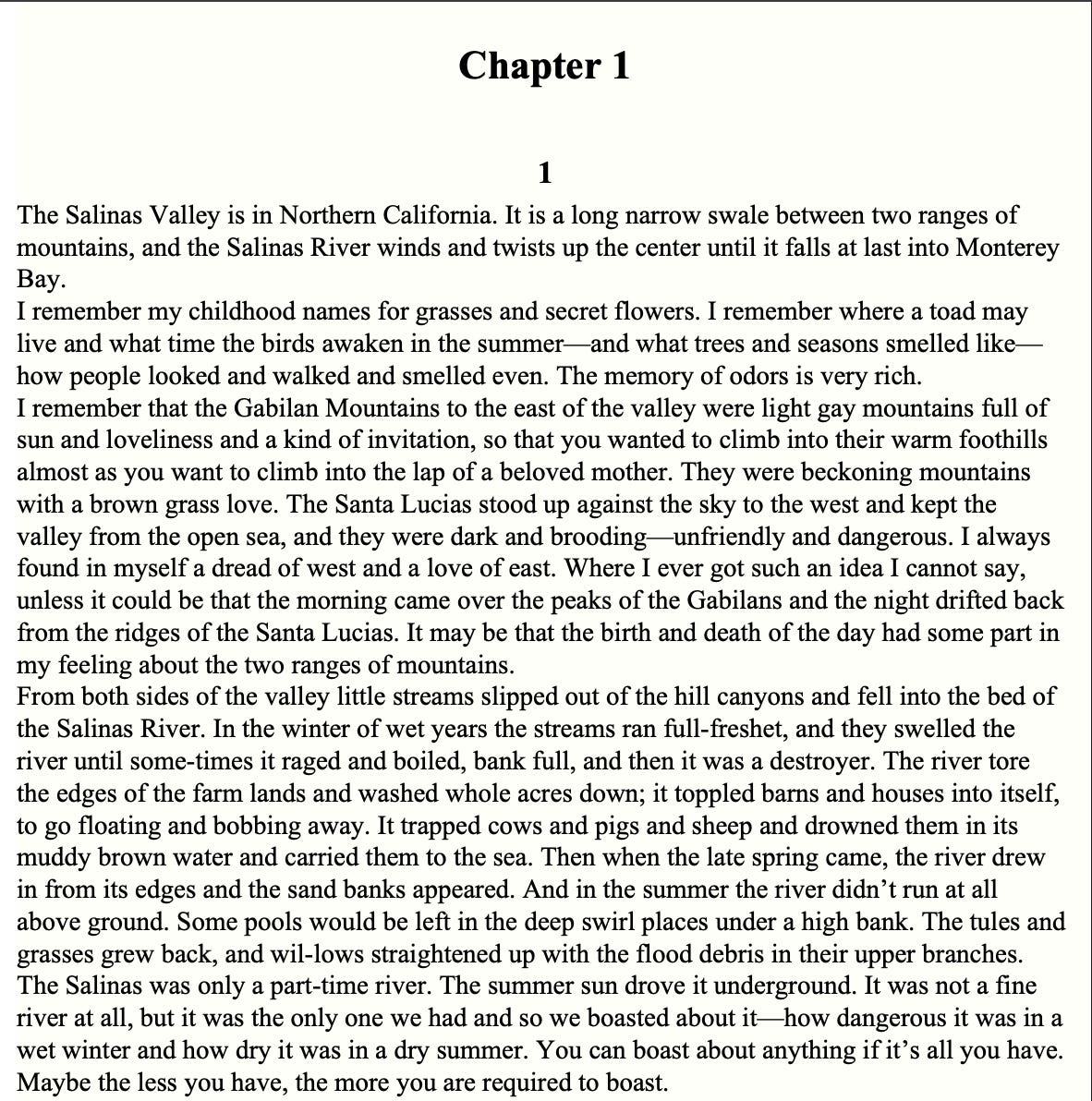
According to this agent, such an opening would go immediately into the “slush pile” of literary rejects because there is no action! There are no stakes! Steinbeck simply gives us a beautiful description of the Salinas Valley
But while I cannot speak to whether this or any other agent would reject East of Eden today, I can’t agree with Libes that Steinbeck “simply gives us a beautiful description of the Salinas Valley.” There is far more than that going on here. Steinbeck is establishing the narrator’s love of place, which is the first note of tension that will carry into the main theme.
The structure here is particularly interesting. The brief opening paragraph gives us a couple of objective sentences describing the geography of the place. But then, as if overcome by an emotion he has striven unsuccessfully to restrain, the narrator plunges into a highly personal and emotional reminiscence, arcing back into childhood. The third paragraph changes the tense to the past. It is less emotionally charged, as if the narrator has mastered his emotions somewhat, but his mind is now firmly in the past. And the fourth paragraph ends with a hint of disaster, of a river driven underground, of a cycle of death and rebirth, and that final note of defiant loss that the less you have, the more you are required to boast.
There is far, far more going on here than a simple description of the Salinas Valley. Is it, as the agent suggests, “giving us a hint of the inciting incident?” Certainly it is giving us a clear opening note and a palpable tension that will carry us through to it. Would this agent recognize the opening of East of Eden as exemplifying her principle, or would she fail to catch the note or pick up on the tension? I cannot possibly tell. But her principle, at least, is correct.
Flowery Writing is Bad
Here Libes says:
Of all terrible literary agent offenses, this one might be my least favorite. The same agent tells us that writing must not contain "poetic prose and metaphors.” She elaborates:
Often times the writers will focus on sounding “literary” and write meandering, prosy or metaphor laden sentences. While it is a style choice, it’s not usually a successful one.
Tip: Flowery prose and metaphor often detract from your writing. You can often make more impact using fewer, but stronger words.
Libes uses Nabokov as an example of a literary great who uses flowery prose. A fierce debate rages in the comments on her post about whether Nabokov’s prose is flowery or not. I will pass no judgment on that matter myself. By and large, I think the agent is right here, but her description of the problem leaves much to be desired.
To begin with, let me shout this from the rooftops: THERE IS NO SUCH THING AS A STRONG WORD. Words are just tokens, neither weak nor strong in themselves. It is only when they are woven into sentences that they have any structure at all. Only a sentence can be weak or strong. But even then, weakness or strength is not really the point. A sentence is either vivid or murky, precise or vague. “Strong” is a weak word in this context.
But the agent is not wrong when she says that “flowery prose and metaphor often detract from your writing.” They often do, because they are often done badly. In fact, if you notice them at all, it is usually because they are done badly. When these things are done well, you don’t notice because they are completely lucid. You see the thing they are pointing to, not the words that do the pointing. It is the attempt by poor writers to sound like a writer without any thought to lucidity of expression that produces the kind of writing that the agent is describing. It might have been more precise if she had said, “Don’t try to sound like a writer, just write as lucidly as you can.” But then, most of the people she is writing for probably wouldn’t know what that meant. That phrasing may be more correct, but it is not as clear or actionable.
This is very much a matter of shaping the message to the audience you are addressing. The agent is writing to the thousands of bad writers that she has read while going through her slush pile. She is adapting her message to their understanding. Now, we might question the wisdom of doing so. These are writers whom she is never going to represent. They are never going to improve enough to be worth her time. She is writing these words out of an instinct of kindness, rather than because it will make any difference to her business, or her slush pile. But she is addressing her remarks to the great horde of aspiring authors in a language they understand.
The nature of Nobokov’s prose aside, then, Libes is objecting to remarks that are not addressed to her, if she is any good as a novelist, and which, though kindly meant, will do her no good if she is not. (Whether she is any good, I have no way to know.)
Your Book Can’t Introduce Too Many Characters in the First Chapter
Libes quotes another agent:
Twelve characters isn’t an opening chapter—it’s a party! And it’s overwhelming. No reader can keep that many new characters straight, especially when two thirds of them are just names. That’s a clear sign you’ve fallen victim to backstory, where you explain your protagonist’s life or describe her predicament in full.
Libes cites Thomas Mann’s Buddenbrooks, which, she says, introduces eleven characters in a seven-page first chapter.
I have no idea if Buddenbrooks pulls it off, but I do know that the agent is going to be right about this 99 times out of a hundred, if not more. This goes back to the need for the string and the bow to be in tension in order to sound a note. If you want to put eleven characters into a seven-page first chapter, you will need to ensure that each one of them is in tension or they will not sound a note and the reader will immediately forget them.
The brain is a finely tuned forgetting machine. It forgets almost everything it sees or hears. It has neither the storage nor the processing power to recall everything. The genius of it is that it remembers the stuff that really matters, the stuff that gives a sufficient illusion of completeness that it actually seems like we have a full, clear picture of things. We don’t, of course. We have a compressed version of the things that matter.
When we read a book, that same finely tuned forgetting machine is at work. Most of us cannot recall every word or even every character and incident in a novel by the time we put it down. Yet, as with real experience, we have seen things along the way that gave us a sense of completeness and coherence in the moment. Our brain then worked on that experience as it does on real-life experience, to forget all that needs to be forgotten so that we have space for what needs to be remembered.
If you introduce eleven characters in the first chapter, you had better be sure that you give the reader’s brain a reason not to forget any of them. This means that you have to put them into dramatic tension. They have to be endowed with potential energy; otherwise, the brain will swiftly and properly dismiss them from memory. Is it possible to endow eleven characters with dramatic tension and potential energy in seven pages? Perhaps. Is it easy? Certainly not. Should we advise novice writers to try? I wouldn’t. Personally, I try to bring my characters on stage one or two at a time, and to immediately put them into tension with characters already introduced and established.
But again, if the writer does manage to introduce eleven characters and place them all in dramatic tension, we won’t notice because we will be absorbed in the story. It is only when the writer trots out name after name without a shred of dramatic tension that we start to feel like we have lost track of the story. The agent is perhaps wrong to say that it is impossible, or that people can’t possibly keep track. But the number of counterexamples is likely to be few.
Sentences Must Not Be Longer Than 15–20 words
Here Libes cites a Reddit discussion to the effect that literary professionals say that no sentence in a novel should be more than 25 words. As the occasional purveyor of long sentences myself, I have a lot of sympathy with Libes on this one. The length of a sentence is not really the point. What counts is its lucidity. If a sentence is lucid, people won’t notice how long it is. If they notice how long it is, it is because it fails to be lucid. Making it shorter may or may not fix the problem, but it is certainly true that, all other things being equal, the difficulty of making a sentence lucid increases with the number of words it contains. Thus there will be a higher percentage of long sentences that are hard to follow.
A lot of writing advice today focuses on symptoms rather than causes. Adverbs are often badly used, so ban adverbs. Long sentences are often hard to follow, so ban long sentences. When addressing someone who has failed to make the difficult thing work, advise them to avoid it completely and try the easier thing instead. Because, of course, that is what this kind of advice is, advice to those of limited skill on what they should do to reach the minimum acceptable level of performance. The writer who succeeds in doing the difficult thing and doing it well is unlikely to be caught in this net because the analytical mind only takes over when it detects a fault. Do the thing well, and most people will not notice that you have violated the writing-for-dummies prescriptions.
We tend to discuss instances before principles, cases before classes. When we see something done badly most of the time, we tend to recommend against doing it at all, as opposed to recommending mastering it. Mastering these things, after all, is not the shortest route to mastering the production of minimally viable commercial fiction.
What do these clues tell us about the way literary advice is formed and expressed? There is a reason that the popular advice is like this. Beginners like simple concrete rules. The real principles of good writing are somewhat abstract. Most great writers learn them not from rules but from exposure to great literature. They learn by osmosis, not instruction. They are blessed with an ear or an eye for the art form. Their knowledge is tacit, rather than explicit, like your knowledge of how to ride a bike or catch a ball.
Less gifted writers don’t have that instinctive grasp of literary technique. They want explicit rules. They want rules that are simple, clear, and actionable. They want rules they can follow without having to stop and think about them too much. They want training wheels permanently welded to their bike.
For example, take a rule like, “Search your manuscript for all instances of ‘said’ and replace them with a more descriptive verb.” This rule is grotesque and absurd, and it is something of a marvel that people take this rule and rules like it seriously. But despite its absurdity, this rule has one highly attractive property: it is clear and actionable. This is what inspires the kind of rules that Libes is objecting to: the demand by a vast swath of the aspiring writer community for rules that are clear and actionable.
The reason that 97.8 percent of all writing rules you read on the internet or learn in workshops are subtly or grossly wrong is that people prefer advice that is clear and actionable, even if it is wrong. Advice that is right, abstract, and hard to put into practice leaves many aspiring writer scratching their head and unable to continue. They’ll take concrete, actionable, and wrong every day of the week.
I have used a musical analogy throughout this post to express what good writing needs to achieve. I hope you will agree that it is a good analogy, and that it helps explain the principles that the rules that Liebs cites are striving for but getting wrong in their attempt to be clear and actionable. Because, say what you like about my musical analogy, it may or may not be clear, but it isn’t actionable. It says what you should be trying to achieve. It does not tell you what words to change in order to achieve it. Thus a great many aspiring writers will say, yes, great analogy, but can you tell me in clear and simple terms what I am supposed to do? I can’t, so they will turn to someone who claims they can. They will turn to someone who offers clear, actionable rules, even if they are wrong.
There are two classes of concrete, actionable writing rules: Those that refer to a valid principle, but distort it to make it clear and actionable, and those that are pure nonsense dreamed up by some hack to satisfy the demand for clear, actionable writing rules. (There is quite a bit of money to be made teaching people clear, actionable writing rules, and the success of this enterprise depends much more on how clear and actionable the rules are and much less on whether they are even a little bit right.)
Most of the rules we looked at above are of the first kind. There is a valid principle behind them, even if the way they are stated sacrifices the nuances of the principle in favor of rules that are clear and actionable. The question, of course, is whether industry professionals, such as agents, are giving flawed but clear and actionable rules because that is what the people they are addressing demand from them, or if they genuinely believe them themselves, as Libes seems to assume.
It’s probably a mix of both, and that does create a genuine problem in the industry. For instance, the straw that broke the camel’s back in my relationship with my erstwhile publisher was an editor’s insistence that I could not use the verb “to feel” because it was “a telling verb.” This is a great example of a rule that is clear, actionable, and wrong. All my attempts to explain why this rule was wrong fell on deaf ears, and I parted company with the publisher.
And in this sense, I have a lot of sympathy with Libes’ frustration with the industry, even if I criticized her specific arguments above. In an attempt to make itself efficient and businesslike, publishing has latched onto a set of rules that are clear, actionable, and wrong, probably because you can hire people to enforce those kinds of rules for not much money.
But back to the original question: Would the classics be published today? If David Copperfield showed up in an agent’s slush pile today, would an unknown and unpublished Dickens get an offer of representation? Probably not. A long autobiographical novel by a straight white male written in an antique style? Long odds to say the least. Beyond that, it tells a story set in an objective, moral universe that is anathema to the postmodernist sensibilities of the modern publishing worker. And, of course, if they showed any interest at all, the agent would insist that Emma Micawber absolutely must leave Mr. Micawber. Besides, it would be an historical novel set in an unfashionable period with a male protagonist who isn’t either a barbarian warrior or a young naval officer. Sorry, Chuck. Try us again with something more modern.
But perhaps that’s not the question. Perhaps the question is, if Charles Dickens had been born in 1987, which would make him today the same age as Dickens was when David Copperfield was published, would he have written the same book in the same style? And the answer to that is obviously no. In fact, he probably wouldn’t have written a book at all. Dickens was, after all, a popular writer ever conscious of the public taste, with an eye always on where the money was coming from. Being very much a public performer, Dickens, if born in 1987, would likely have gone into television. Taylor Sheridan’s TV formula of mixing bloody violence, high romance, and ostentatious moral posturing would have suited Dickens down to the ground.
I’m not saying, of course, that writers should just go along with the dictates of the literary culture of their day. I am in rebellion against that culture myself. Literary rebellion has produced many great works in the past, The Lord of the Rings among them. But literary rebellions are not made simply by producing a pastiche of earlier forms. They are very much shaped by the thing that they rebel against. This is my caution to those people who say they want to create a new generation of Inklings. The Inklings were shaped by a rebellion against the literary forms of their time. The problem now is different. We need a new revolution, not a pastiche of the old one.
The classics are great, and they reward the effort it takes to accommodate the ear to their antique style and to learn the meaning of their no-longer-current references. But we have to remember that it was not their style that made them great. There were thousands upon thousands of works written in a similar style that were not as great and have faded from view. What we should note, though, is that the readers of that time were attuned to that style. The readers of our own day are not. Imitating Dickens’ style won’t make you a great writer; it will just make your work more obscure and less approachable to the modern reader. Caving to the style dictates of the moment won’t make you a great writer either. Style and substance are related. The medium is the message. More on this another time.
The problem with the modern publishing industry is not that it rejects the writing styles of writers long dead. Nor is it that agents and writing teachers give bad stylistic advice because it is clear and actionable and that is what people ask for. The rot goes far deeper than either of these things. It has to do with ideological capture and also with the industrialization of storytelling and the associated genrification of literature.
The problem with literary rules and literary advice, however, has little to do with these things, though the industrialization of storytelling does play something of a role. The problem lies with a different, though related, industry, which we might call the writer services industry. If very few writers are making a living at their craft, lots of people are making a living in the writer services industry, including many of the aspiring writers themselves who moonlight as editors and book coaches. Many of these people are sincere and give the best advice and service they can. Some of them are frauds and charlatans. Some of them are sincere but deluded. But though they are, by and large, the purveyors of these writing rules that are clear, actionable, and wrong, they are not to blame for them either.
So who is to blame? The blame lies with the hordes of aspiring writers who are ready and willing to consume these services and pay for them, but demand in return not frou-frou analogies to music but clear, actionable rules about which words to use and how long sentences should be and when to introduce the main character. The language that these aspiring writers demand has become the language of the front line of the publishing industry. It does no good to blame the agents who speak this language. They are speaking to us in our own language. We have no one to blame but ourselves.
Your string and bow analogy has helped me work out how my own novel might start, so thank you! Lots to chew on in the rest of the piece as well; I will be bookmarking it to return to again.
Wow. Loved your diagnoses of the problem—writers prefer clear, actionable rules (that are nearly always wrong or oversimplified) over true but hard-to-master principles. And so the author-services world gives it to them in spades.
Side note: I once read a book by a young debut author that never once used "he said/she said," and hardly ever used dialogue tags at all (preferring, instead, action tags). When I noticed it (which actually wasn't until after the first read-through), I laughed out loud, because I knew exactly what must have happened in this young writer's progression.